Choosing the best solar company Calgary or Edmonton isn’t just about finding the lowest price per panel.
A residential solar system can operate for 30 years or longer, which means you’re also choosing the company responsible for designing the system, installing it on your home, navigating permits and utility approvals, standing behind its workmanship, and helping you if something goes wrong years after installation.
So, how do you find the best solar company in Calgary or the best solar company in Edmonton?
There isn’t one specification that determines whether a solar installer is “the best.” Instead, homeowners should compare installers across several factors: local experience, system design, projected production, equipment, warranties, installation quality, after-sales support, reputation, and – most importantly – the assumptions behind the financial return they’re promising.
This guide explains what Alberta homeowners should compare before choosing a solar installer in 2026.
Table of contents
- Start with the company’s Alberta track record
- Don’t compare solar quotes on price alone
- Understand how Alberta’s electricity market changes solar economics
- Compare solar production, not just the number of panels
- Compare the equipment but don’t obsess over panel brands
- Look closely at the workmanship warranty
- Find out who actually installs and services your system
- Check engineering, permits and utility interconnection
- Check reviews – but read the bad ones too
- Look for independent recognition and third-party proof
- Understand solar financing before signing
- Be careful with “solar rebates” in Alberta
- Calgary vs. Edmonton: Does location affect your solar system?
- Ask what happens after installation
- Download our solar company comparison checklist
- Why Alberta homeowners choose Zeno Renewables
- Frequently asked questions
- Ready to find out whether solar makes sense for your home?
Quick answer: What should you look for in an Alberta solar company?
The best solar companies in Calgary and Edmonton should be able to demonstrate:
- Extensive experience installing solar in Alberta
- A strong history of completed local installations
- Proper engineering, permitting and electrical compliance
- Transparent solar production and savings calculations
- Strong workmanship and equipment warranties
- Established service and warranty support
- Experience navigating Alberta’s micro-generation process
- Knowledge of financing programs such as CEIP
- Strong, verifiable customer reviews
- A track record that suggests the company will still be around to support your system years from now
Price matters, but the cheapest solar quote is not necessarily the best-value solar quote.
The quality of the design, assumptions behind the savings estimate, equipment selection, installation and long-term support can matter considerably more over the life of the system.
1. Start with the company’s Alberta track record
Solar is a long-term home improvement, so company history matters.
Ask:
How long has the company actually installed solar in Alberta?
A company may have existed for years while only recently entering solar or entering the Alberta market.
Look for evidence such as:
- Completed projects in your city
- Residential and commercial installations
- Local customer reviews
- Established Calgary or Edmonton operations
- Long-term employees and installation teams
- Projects completed several years ago that are still operating
Experience also matters because Alberta isn’t one homogeneous solar market.
A company like Zeno installing systems in Calgary, Edmonton, Lethbridge and other Alberta communities encounters different utilities, permitting processes, roof types, weather conditions and site constraints.
Why local experience matters
A solar installer isn’t simply attaching panels to a roof.
Before installation, the company needs to evaluate factors including:
- Roof orientation
- Roof pitch
- Available roof area
- Shading
- Structural conditions
- Electrical service
- Annual electricity consumption
- Local permitting requirements
- Utility interconnection requirements
- Snow and wind loads
An experienced Alberta installer should be able to explain how those factors influenced your specific design, rather than simply showing you a standard package.
2. Don’t compare solar quotes on price alone
This may be the most important part of choosing a solar company.
Two companies can quote similar-looking systems and produce very different financial projections.
Imagine:
Installer A
$20,000 system
Claims $100,000 in lifetime savings
Installer B
$18,500 system
Claims $70,000 in lifetime savings
Installer A may appear to offer a dramatically better investment.
But what assumptions produced that $100,000 number?
That’s what you need to investigate.
Ask every solar company to show you:
System size
Usually measured in kilowatts (kW).
Estimated annual production
How many kilowatt-hours (kWh) should the system generate each year?
Your historical electricity consumption
Was the system actually designed around your household’s usage?
Electricity price assumption
What electricity rate was used when estimating savings?
Electricity inflation assumption
How much does the proposal assume electricity prices will increase every year?
Panel degradation
Solar panels gradually produce less electricity over time. Is that included?
Solar export assumptions
How much generated electricity does the model expect you to consume versus export to Alberta’s grid?
Financing costs
If you’re financing the installation, are borrowing costs included in the payback calculation?
The question every homeowner should ask
“Can you show me exactly which assumptions you used to calculate my payback period and lifetime savings?”
A trustworthy installer should be able to answer that clearly.
If a company can’t explain where its numbers came from, don’t base a 25-year investment on them.
3. Understand how Alberta’s electricity market changes solar economics
Alberta’s electricity market makes solar somewhat different from solar in other Canadian provinces.
Under Alberta’s Micro-generation Regulation, homeowners with qualifying systems can generate electricity for their own use and receive credits for excess electricity exported to the grid.
For small micro-generators, excess electricity is credited through the homeowner’s electricity retailer.
That makes your electricity plan an important part of your solar economics.
Why your electricity retailer matters after going solar
Solar homeowners generally produce the most electricity during Alberta’s long summer days.
During periods when your system generates more electricity than your home is consuming, that excess electricity flows onto the grid and generates credits.
That means homeowners shouldn’t only ask:
“How much electricity will my panels generate?”
They should also ask:
“What happens to the electricity I don’t use?”
Your installer should be able to explain:
- How Alberta micro-generation works
- How exported electricity is credited
- What happens to accumulated credits
- How an energy retailer like Zeno Energy affects those credits
- How seasonal electricity plans offered through Solar Club® affect solar economics
Zeno Energy is Alberta’s local electricity, natural gas, and internet retailer. Backed by the team behind Zeno Renewables, we help Albertans take control of their energy costs with competitive utility plans, Solar Club rates, and straightforward customer service – all while giving back, with 10% of our revenue supporting KidSport programs across Alberta.
A strong solar proposal considers the entire energy picture – not just the panels.
4. Compare solar production, not just the number of panels
More panels doesn’t automatically mean a better solar system.
A well-designed 16-panel system can potentially outperform a poorly designed 18-panel system depending on:
- Panel wattage
- Roof orientation
- Shading
- Pitch
- Inverter configuration
- Snow coverage
- Equipment efficiency
- Array placement
That’s why annual projected production in kWh is one of the most useful numbers for comparing quotes.
For example:
| Quote | System Size | Estimated Annual Production |
| Company A | 7.2 kW | 8,300 kWh |
| Company B | 7.2 kW | 7,600 kWh |
| Company C | 7.6 kW | 8,350 kWh |
Now you have a much better comparison than simply asking how many panels each installer included.
Ask how the production estimate was calculated
A credible installer should consider the characteristics of your actual roof rather than using a generic Alberta production number.
Factors such as nearby trees, chimneys, neighbouring buildings and different roof faces can significantly change production.
5. Compare the equipment but don’t obsess over panel brands
Homeowners often spend a lot of time comparing solar panel brands.
Equipment matters, but the name printed on the panel is only one part of the system.
A solar installation includes:
- Solar panels
- Inverters or microinverters
- Racking
- Electrical components
- Monitoring
- Engineering
- Installation workmanship
And these pieces need to work together for decades.
Questions to ask about solar panels
- Who manufactures them?
- What is the product warranty?
- What is the performance warranty?
- What degradation rate is guaranteed?
- Is the manufacturer established in Canada?
- Who handles a warranty claim?
Questions to ask about the inverter
Your inverter converts the electricity produced by the panels into electricity your home can use.
Ask:
- What inverter technology is being proposed?
- Why was it selected for my roof?
- What is its warranty?
- What happens if it fails?
- Who diagnoses and replaces it?
The best equipment isn’t necessarily the most expensive equipment.
It’s the equipment that makes sense for your home, is properly designed into the system, has strong warranty backing and can realistically be serviced in the future.
6. Look closely at the workmanship warranty
Solar panels often come with manufacturer warranties lasting 25 years or more.
But that doesn’t necessarily mean the installation itself is covered for that long.
Those are different warranties.
Manufacturer warranty
Typically covers the solar equipment itself.
Workmanship warranty
Covers issues related to how the system was installed.
This distinction matters because many problems homeowners could encounter aren’t panel manufacturing defects.
They may involve:
- Roof penetrations
- Racking
- Wiring
- Conduit
- Installation workmanship
- Electrical connections
Ask every installer:
“What does your workmanship warranty cover, how long does it last, and who performs the service?”
Then get the answer in writing.
Zeno warranties: We protect your investment
- Installation: Lifetime craftsmanship and labour warranty on the solar PV system and its supporting components
- Production Guarantee: We pay the difference if your system underperforms by more than 5%
- Solar Modules: 30-year manufacturer power output warranty and limited product warranty
- Microinverters (APS): 25-year manufacturer limited product warranty
- String Inverters & Optimizers (SolarEdge): 12-year (ext. to 25-year) on string inverter. 25-year manufacturer limited product warranty on optimizers
- Racking: 20-year manufacturer limited product warranty
- Energy Storage: 10-year manufacturer limited product warranty
- Post-Install Support: A true partner, offering in-house support through our dedicated support team

7. Find out who actually installs and services your system
This question is often overlooked.
Ask:
“Who will actually be on my roof installing this system?”
Some solar companies manage installation internally. Others rely heavily on subcontractors.
Using subcontractors isn’t automatically bad. What matters is accountability.
You should understand:
- Who manages the installation
- Who performs electrical work
- Who handles deficiencies
- Who you contact after installation
- Whether service technicians are available locally
- Who handles equipment warranty claims
The company selling the system should remain accountable for the result.
8. Check engineering, permits and utility interconnection
Professional solar installation requires much more than putting panels on a roof.
Depending on the project and municipality, the process can involve:
- System design
- Structural review
- Electrical design
- Municipal permits
- Electrical permits
- Utility applications
- Micro-generation approval
- Inspection
- Metering
- Commissioning
Ask the installer exactly which parts of this process they handle.
For most homeowners, the ideal answer is: All of it.
A turnkey solar company should guide the project from initial design through system activation rather than leaving homeowners to coordinate multiple technical steps themselves. Zeno is a true turnkey company taking care of all of the above and more such extensive post-install support and client benefits like our generous referral program.
9. Check reviews – but read the bad ones too
Star ratings are useful, but don’t stop there.
Look for companies with a meaningful number of reviews accumulated over several years.
Then specifically read:
- Recent reviews
- One-star reviews
- Two-star reviews
- Reviews written months after installation
- Reviews mentioning service or warranty claims
You’re looking for patterns.
Every company operating at scale will eventually have unhappy customers. A perfect review record can actually tell you less than seeing how a company responds when something goes wrong.
Pay attention to complaints involving:
- Communication
- Installation delays
- Unexpected costs
- Roof damage
- Production expectations
- Warranty support
- Service response
Then look at how the company responded.
The true test of a solar installer isn’t only how it behaves when everything goes right. It’s how it responds when something doesn’t.
10. Look for independent recognition and third-party proof
Every solar company’s website will tell you it’s trustworthy.
Independent evidence carries more weight.
Look for:
- Third-party awards
- Industry recognition
- Professional certifications
- BBB accreditation
- Verified customer reviews
- Industry memberships
- Established community partnerships
- A portfolio of real installations
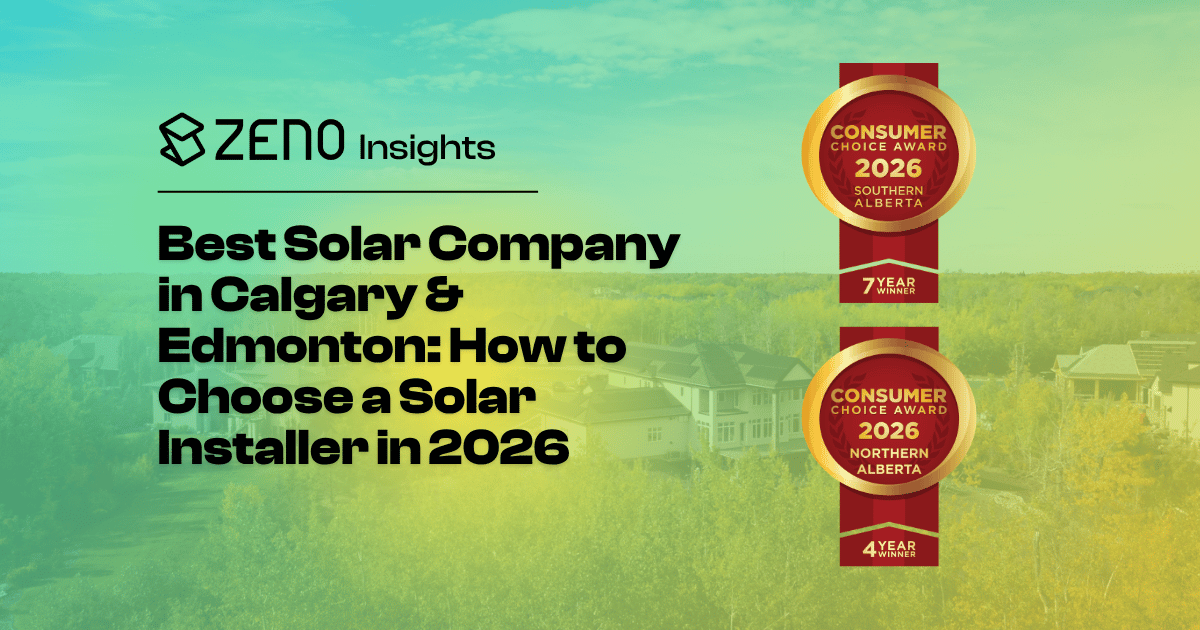
Zeno Renewables: Consumer Choice Award Winner in Northern and Southern Alberta
Zeno Renewables was named the 2026 Consumer Choice Award winner for Solar Energy Systems in both Southern Alberta and Northern Alberta.
Consumer Choice Award uses independent market research to evaluate businesses based on factors including brand reputation, customer satisfaction and business excellence.
For homeowners searching for the best solar company in Calgary or best solar company in Edmonton, independent recognition is another useful signal alongside reviews, warranties, experience and installation history.
Zeno has received Consumer Choice Award recognition for seven consecutive years in southern and 4 consecutive years in northern Alberta, reflecting an established track record rather than a single recent project or campaign.
Have a peak at all our awards and recognition.

11. Understand solar financing before signing
Solar can be purchased outright or financed.
One Alberta-specific option homeowners may encounter is the Clean Energy Improvement Program (CEIP).
CEIP is available through participating Alberta municipalities and can provide financing for eligible energy-efficiency and renewable-energy upgrades.
Importantly:
CEIP is financing, not free money or a universal solar rebate.
Availability, intake periods, interest rates, incentives and eligibility requirements vary by municipality.
For example, Calgary’s residential CEIP can finance up to 100% of eligible project costs, to a maximum of $50,000, with repayment through the property’s tax bill.
Before selecting any financing option, compare:
- Interest rate
- Loan term
- Total borrowing cost
- Monthly or annual payment
- Early repayment rules
- Whether financing is attached to you or the property
- Expected solar savings during the financing period
Don’t evaluate solar based solely on whether the monthly financing payment looks manageable.
Evaluate the total economics of the project.
12. Be careful with “solar rebates” in Alberta
This is an area where outdated solar information spreads quickly online.
Programs open, close, become fully subscribed or change their eligibility rules.
For example, Edmonton’s previous residential Solar Rebate Program is currently fully subscribed and no longer accepting applications.
CEIP programs also vary by municipality and may periodically pause or reopen for applications.
If an installer tells you that a rebate dramatically reduces your price, ask:
- What is the exact name of the program?
- Am I currently eligible?
- Is the program accepting applications today?
- Is the incentive guaranteed?
- Is it a rebate, grant, loan or financing program?
- What happens to my contract price if I don’t receive it?
Never sign a solar contract based on an incentive you haven’t verified.

13. Calgary vs. Edmonton: Does location affect your solar system?
Yes, but both cities are strong solar markets.
Choosing the Best Solar Company in Calgary
Calgary receives abundant sunshine and has a large established residential solar market.
When comparing Calgary solar companies, ask about:
- Experience installing within Calgary
- Calgary permitting
- Your local distribution utility
- CEIP eligibility and current intake status
- Snow and wind engineering
- Solar production assumptions for your specific roof
- Local service availability
Your installer should also account for Calgary-specific shading, roof orientation and solar potential rather than applying a generic Alberta estimate.
Choosing the Best Solar Company in Edmonton
Edmonton is also well suited to solar.
The City of Edmonton reports approximately 2,300 hours of sunshine in an average year, making Edmonton one of Canada’s sunniest cities.
When comparing Edmonton solar installers, ask about:
- Edmonton installation history
- Utility interconnection experience
- Local permitting
- Cold-weather system design
- Snow management assumptions
- Local service availability
- Current financing and incentive programs
And remember that Edmonton’s previous residential solar rebate is currently fully subscribed, despite older articles online that may still promote it.
14. Ask what happens after installation
Your relationship with a solar company shouldn’t end when the crew leaves.
After installation, you’ll typically want access to monitoring software showing how much electricity your system is producing.
Ask:
- Who activates my monitoring?
- Will someone show me how to use it?
- What should my system produce annually?
- What happens if production suddenly falls?
- Who do I contact for technical support?
- Who handles manufacturer warranty claims?
- What happens if I need roof work in the future?
- What happens if I sell my house?
A company planning to support customers long term should have clear answers.
Red flags when comparing Calgary or Edmonton solar companies
Be cautious if you encounter:
- High-pressure “sign today” pricing
- Savings claims without clearly stated assumptions
- An unusually short or vague workmanship warranty
- Rebates that can’t be independently verified
- No explanation of projected annual production
- No shading analysis
- No explanation of who performs the installation
- No clear post-installation service process
- Equipment manufacturers you can’t easily research
- Extremely aggressive electricity inflation assumptions
- A company unwilling to provide references or examples of local projects
- A quote focused almost entirely on monthly financing payments instead of total system cost
Green Flags
Look for:
- Years of Alberta installation history
- Hundreds or thousands of completed projects
- Verifiable Calgary and Edmonton installations
- Detailed production estimates
- Transparent financial assumptions
- Clear equipment specifications
- Strong workmanship warranty
- Established local service capabilities
- Clear engineering and permitting processes
- Verifiable customer reviews
- Independent industry recognition
- Straightforward explanations without pressure
15. Download our solar company comparison checklist
Before signing a contract, compare at least two or three proposals using the same criteria. Feel free to download our checklist to evaluate your options.
When comparing solar companies in Alberta, look beyond the initial price and evaluate the complete value of each proposal. Compare the total installed price, system size (kW), estimated annual solar production (kWh), price per watt, and expected electricity offset to understand what you’re actually getting for your investment.
Review the specific solar panel and inverter manufacturers and models, along with their product, performance, and inverter warranties, and pay close attention to the installer’s workmanship warranty. You should also compare the estimated payback period and the assumptions used to calculate it, including future electricity price increases.
If you’re financing your solar installation, consider both the interest rate and total financing cost rather than focusing only on the monthly payment. Finally, consider the company’s years of experience installing solar in Alberta, local Calgary or Edmonton installations and customer reviews, and whether it has a local service team that can support your system after installation.
Tip: Don’t automatically choose whichever column has the lowest price. Choose the proposal with the strongest combination of realistic production, transparent economics, installation quality, warranty protection and long-term support.
16. Why Alberta homeowners choose Zeno Renewables
Zeno Renewables has been helping homeowners generate their own electricity for more than a decade, with thousands of solar installations completed and several hundreds of positive reviews.
Our experience includes residential and commercial projects across Alberta, including Calgary, Edmonton and surrounding communities.
Zeno was also recognized as the 2026 Consumer Choice Award winner for Solar Energy Systems in both Northern Alberta and Southern Alberta, continuing multiple years of Consumer Choice Award recognition.
But awards shouldn’t be the only reason you choose a solar installer.
We believe homeowners should compare us using the same criteria outlined in this guide:
Experience. Design. Production. Price. Warranty. Installation quality. Transparency. And long-term support.
That’s why every Zeno solar proposal is designed around the individual home and its electricity consumption rather than simply selling a predetermined number of panels.
17. Frequently asked questions
What is the best solar company in Calgary?
There isn’t one factor that determines the best solar company in Calgary. Homeowners should compare local installation experience, projected solar production, equipment, workmanship warranties, customer reviews, financial assumptions and long-term service support.
Zeno Renewables has operated in Alberta for more than a decade and was named the 2026 Consumer Choice Award winner for Solar Energy Systems in Southern Alberta.
What is the best solar company in Edmonton?
When choosing the best solar company in Edmonton, look for an installer with extensive Alberta experience, local Edmonton installations, transparent production estimates, strong warranties and established after-sales support.
Zeno Renewables was named the 2026 Consumer Choice Award winner for Solar Energy Systems in Northern Alberta and has completed residential and commercial solar projects in the Edmonton area.
How many solar quotes should I get?
Getting two or three solar quotes can help you understand differences in system size, equipment, pricing, warranties and estimated production. However, it’s important to compare the assumptions behind each proposal rather than simply choosing the cheapest quote.
At Zeno, we can provide a custom solar quote and system design based on your home, electricity usage and energy goals.
How much do solar panels cost in Alberta?
The cost depends on the size of the system, equipment, roof complexity, electrical requirements and installation conditions. A custom solar assessment is the best way to determine the appropriate system size and installed cost for a specific home.
When comparing prices, consider both the total installed price and price per watt, but don’t use price per watt as the only measure of value.
How long does it take solar panels to pay for themselves in Alberta?
We’ve put together a handy guide outlining the average cost of common solar projects in Alberta. However, solar costs and payback periods can vary considerably from one home to another.
It depends on factors including:
- Installed system cost
- Annual electricity consumption
- Solar production
- Electricity rates
- Export credits
- Financing costs
- Future electricity prices
Be cautious of any installer promising a universal payback period without first reviewing your home’s electricity consumption and solar potential.
Does Alberta have net metering for solar panels?
Alberta uses a micro-generation framework that allows eligible homeowners to generate electricity for their own use and receive credits for electricity exported to the grid.
For small micro-generators, exported electricity is credited through the homeowner’s electricity retailer like Zeno Energy.
Does Alberta still have solar rebates in 2026?
There is no single universal Alberta residential solar rebate. Some municipalities offer financing or incentives through programs such as CEIP, but availability and eligibility vary.
Homeowners should verify current programs before signing a solar contract because incentive programs can change, pause or become fully subscribed.
Is CEIP a solar rebate?
No. The Clean Energy Improvement Program (CEIP) is primarily a financing program that allows eligible property owners in participating Alberta municipalities to finance qualifying energy improvements and repay the financing through their property tax bill.
Some participating municipalities may separately provide incentives.
Do solar panels work during Alberta winters?
Yes. Solar panels continue producing electricity during Alberta winters whenever sufficient sunlight reaches the panels. Cold temperatures themselves don’t prevent photovoltaic panels from operating.
Annual solar projections should account for seasonal changes in sunlight, weather and expected production.
Should I choose the cheapest solar company?
Not necessarily. A cheaper installation can become expensive if production is lower than expected, installation quality is poor or service isn’t available when something fails.
Compare total price, projected production, equipment, warranties, financial assumptions and long-term support before deciding.
What questions should I ask a solar company before signing?
At minimum, ask:
- How much will my system produce annually?
- How was that estimate calculated?
- What assumptions are used in my savings projection?
- What equipment are you installing?
- What warranties apply?
- Who handles warranty claims?
- What happens if my system stops producing?
- What permits and utility applications do you handle?
- Can I see examples of installations near me?
A reputable installer should be comfortable answering all of them.
18. Ready to find out whether solar makes sense for your home?
The best way to compare solar isn’t through a generic online estimate.
It’s by looking at your electricity consumption, your roof, your available solar exposure and the economics of your specific home.
Zeno Renewables can assess your property and build a free custom solar proposal showing:
- Recommended system size
- Estimated annual production
- Expected electricity offset
- Equipment
- Installed cost
- Available financing options
- Long-term savings estimates
Whether you’re searching for the best solar company in Calgary, the best solar company in Edmonton, or simply trying to determine whether solar makes financial sense for your Alberta home, start with the numbers.
Request a free solar assessment and see what solar could look like for your home.