TL;DR – EV chargers installation is more than just mounting a unit on your garage wall. It involves electrical capacity checks, permits, safety standards, long term operating costs, and sometimes solar integration. For many homeowners, installing a Level 2 EV charger at home can reduce charging costs, increase convenience, and even boost property value. This guide explains what to expect, how much it costs, what to watch out for, and how to decide if it makes sense for your home.
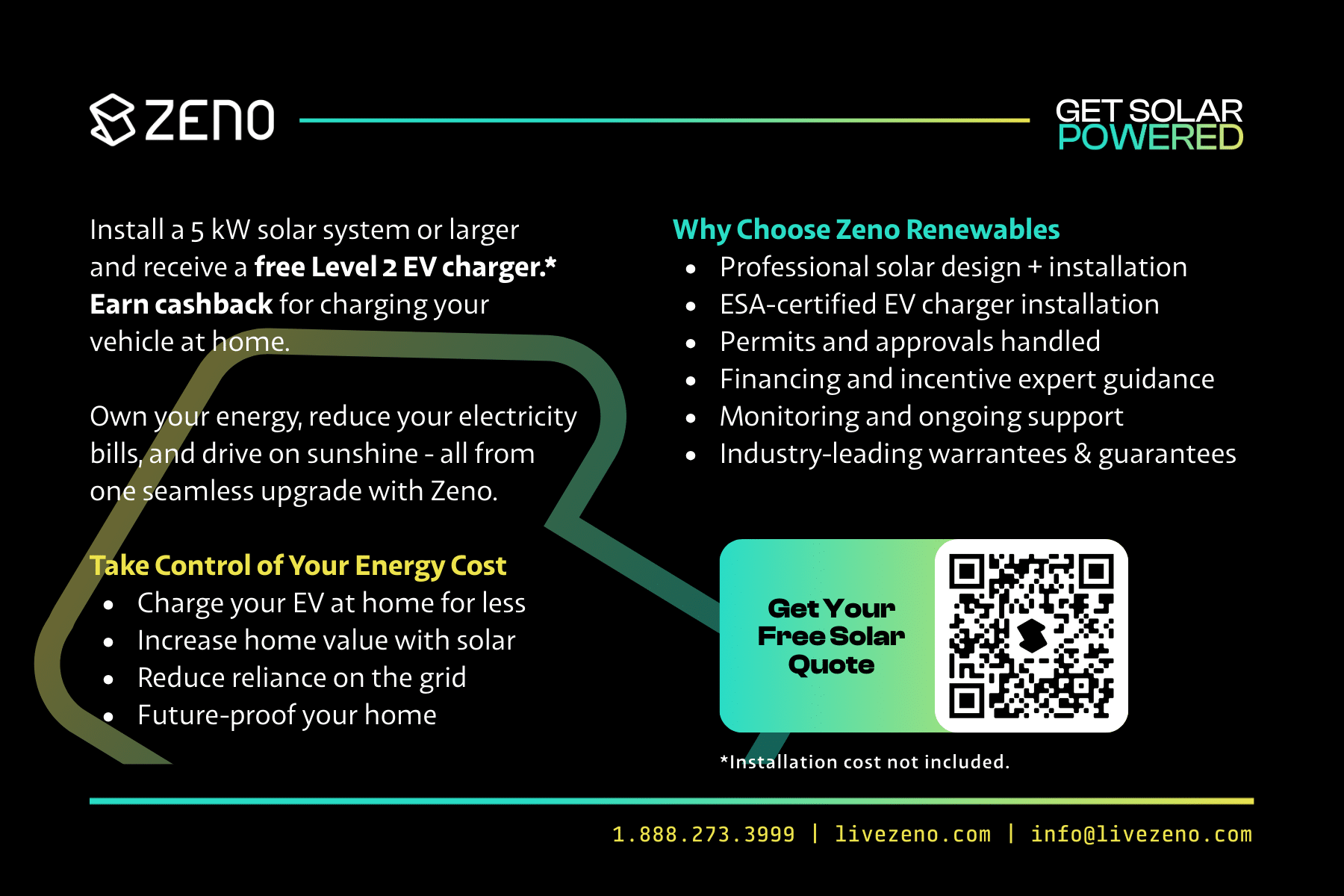
Promo Now On: When paired with a solar system installation, homeowners can claim a free Level 2 EV charger through our current promotion, making the economics even more compelling. Power your home and charge your ride with Zeno – get a Free Solar Quote today.
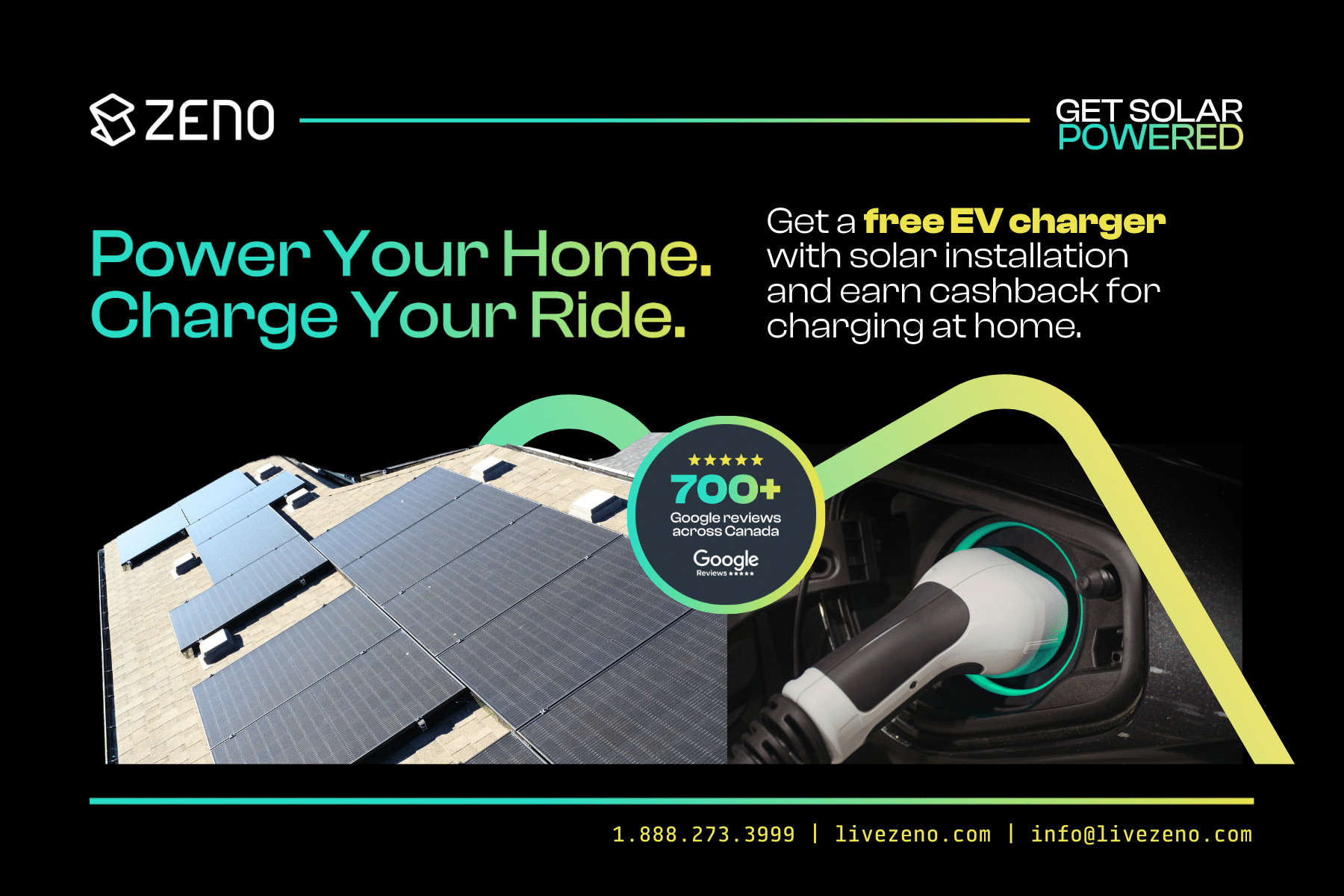
Table of contents
- What EV chargers installation really involves
- Level 1 vs Level 2 charging at home
- Electrical panel capacity and safety requirements
- EV chargers installation costs
- How solar changes the math & Zeno solar + EV charger promo
- Permits, inspections, and professional standards
- Common downsides and limitations
- Does EV chargers installation increase home value?
- Integrating EV charging with energy management
- When EV chargers installation makes the most sense
- Key takeaways
What EV chargers installation really involves
When homeowners search for EV chargers installation, they often assume it is a simple plug and play project. In reality, it is a structured electrical upgrade that should follow provincial safety standards.
A proper installation typically includes:
- Assessing your main service panel capacity
- Confirming available breaker space
- Installing a dedicated 240 volt circuit for Level 2 charging
- Mounting and wiring the charger
- Securing permits where required
- Final inspection and testing
In Canada, electrical work must comply with the Canadian Electrical Code and local authority requirements. In Ontario, for example, the Electrical Safety Authority outlines strict requirements for EV charging equipment installation. In Alberta, electrical permits and inspections are also mandatory for most hardwired chargers.
Professional EV chargers installation protects your home, your vehicle, and your insurance coverage.

Level 1 vs Level 2 charging at home
Before investing in EV chargers installation, it helps to understand the difference between charging levels.
Level 1 charging
- Uses a standard 120 volt outlet
- Adds roughly 6 to 8 km of range per hour
- No special installation required
Level 1 can work for low mileage drivers. However, for many households it is simply too slow.
Level 2 charging
- Uses 240 volts
- Adds roughly 25 to 45 km of range per hour depending on vehicle and charger size
- Requires professional EV chargers installation
According to Natural Resources Canada, Level 2 charging is the most common home charging method because it balances speed, cost, and convenience. It allows most drivers to fully recharge overnight.
For homeowners who commute daily, Level 2 charging is usually the practical choice.
Electrical panel capacity and safety requirements
One of the most important steps in EV chargers installation is verifying panel capacity.
Most Level 2 chargers require:
- A 30 to 60 amp breaker
- A dedicated 240 volt circuit
- Proper grounding and bonding
If your home has a 100 amp service panel, there may not be enough capacity to add a 40 or 50 amp EV charger without a load calculation. In some cases, you may need:
- A panel upgrade
- A subpanel
- Load management devices
Load calculations are required by code and help ensure your home does not exceed safe operating limits. Overloading a panel can create fire risk and nuisance breaker trips.
Professional installers typically perform a full load calculation based on your HVAC, range, dryer, and other high demand appliances before recommending equipment.
EV chargers installation costs
The cost of EV chargers installation depends on several factors:
- Distance from panel to charger location
- Panel capacity
- Type of charger
- Permit requirements
- Wall mounted versus pedestal installation
For most homes, installing an EV charger typically ranges between $1,500 and $3,000 for a straightforward setup. If your electrical panel needs to be upgraded to support the charger safely, costs can increase to $3,500 or more.
One additional factor that can impact pricing is whether the charger is being installed in an attached or detached garage. A detached garage can sometimes increase costs because it may require trenching and running new wiring from the main electrical panel in the house to the garage. The key consideration is whether the existing wiring between the house and garage is large enough to handle the added electrical load. If it is, the installation may still be considered straightforward, just toward the higher end of the typical range. If not, additional electrical work would be required, which increases the overall investment.
Equipment costs for Level 2 chargers vary depending on brand and features such as:
- WiFi connectivity
- Energy monitoring
- Smart charging schedules
If you are already evaluating solar installation costs, it can make sense to assess EV charging at the same time. Bundling projects can reduce mobilization and inspection fees.

How solar changes the math
Electric vehicles reduce tailpipe emissions, but electricity still has a cost. Charging at home increases household electricity consumption. The average EV can consume between 15 and 25 kWh per 100 km depending on driving style and vehicle type.
Pairing EV chargers installation with rooftop solar can help offset that added consumption.
According to the National Renewable Energy Laboratory in the United States, charging an EV with home solar can significantly reduce lifecycle emissions compared to grid only charging, especially in regions with traditional fuel heavy grids.
In Alberta, where electricity rates can fluctuate and distribution charges make up a large portion of bills, solar generation during daytime hours can improve long term energy cost stability.
If you are unsure whether your roof can offset your EV charging needs, our Solar Savings Calculator can help estimate potential production, offset percentages, and long term savings based on your actual consumption.
Zeno solar + EV charger promotion for homeowners: Power Your Home. Charge Your Ride.
For homeowners installing a 5 kW solar system or larger, we are offering a free Level 2 EV charger as part of a bundled upgrade. Note that installation cost for the charger is not included.
This type of bundled offer can improve return on investment, especially for households already considering solar.
A Free Solar Quote can clarify whether your roof size, energy use, and driving habits make this combination financially sensible.
Permits, inspections, and professional standards
EV chargers installation is not a DIY friendly upgrade for most homeowners.
In many provinces:
- Electrical permits are mandatory
- Inspections are required before energizing the circuit
- Only licensed electricians can perform the work
The Electrical Safety Authority in Ontario and municipal permitting offices in Alberta require compliance with local codes. Insurance providers may also require proof of permitted work in the event of a claim.
Professional installation typically includes:
- Permit submission
- Inspection coordination
- Final testing
- Documentation for your records
Skipping permits can create issues during home resale. Buyers and home inspectors often ask for documentation of major electrical upgrades.
Common downsides and limitations
While EV chargers installation offers convenience and potential cost savings, it is not without tradeoffs.
Upfront costs
Installation can be expensive, especially if panel upgrades are needed.
Time of use rates
In Ontario, time of use pricing can impact charging costs. Charging during peak hours may be more expensive unless you schedule overnight sessions.
Grid constraints
In some neighborhoods, distribution infrastructure may limit large service upgrades.
Space constraints
Garage layout, wall space, and conduit routing can affect installation complexity.
Balanced decision making means considering these factors honestly.
Does EV chargers installation increase home value?
There is growing evidence that EV readiness can enhance property appeal.
A 2025 Nature Communications study found that increasing access to electric vehicle charging infrastructure was associated with significantly higher EV adoption rates. As electric vehicle ownership rises, the demand for convenient home charging increases as well.
While direct resale value increases vary by region and market conditions, EV chargers installation can:
- Make your home more attractive to EV owners
- Reduce buyer hesitation about charging logistics
- Signal modern, future-ready infrastructure
For buyers who already own an electric vehicle, a home with a Level 2 charger installed eliminates one immediate upgrade expense.
When paired with solar, the home becomes an integrated energy system rather than just a residence, offering both mobility and electricity independence in one package.
Integrating EV charging with energy management
Modern Level 2 chargers often include:
- Smart scheduling
- Energy monitoring
- App based controls
Some systems can integrate with solar production monitoring to prioritize charging when solar output is high.
This integration can shorten your effective solar payback period by maximizing self consumption rather than exporting excess power to the grid at lower credit rates.
A Free Solar Quote can help determine if your panel size, inverter capacity, and energy usage profile align with EV charging integration.
When EV chargers installation makes the most sense
You are likely a strong candidate if:
- You drive more than 15,000 km per year
- You plan to own an EV long term
- Your panel has sufficient capacity
- You are already considering rooftop solar
- You want predictable charging convenience
It may make less sense if:
- You drive very short distances
- You rely mostly on workplace charging
- Your home requires a costly service upgrade
The decision should be practical, not emotional.
How to evaluate your next step
If you are early in research mode, start by reviewing your annual electricity consumption and estimating how much additional usage your vehicle will require.
Then consider:
- Current utility rates
- Future vehicle plans
- Roof condition and orientation
- Available solar incentives
Many homeowners explore solar incentives at the same time to understand rebates, financing options, and municipal programs.
A Solar Savings Calculator can provide a starting estimate without requiring commitment.
Once you are closer to a decision, a Free Solar Quote can clarify system sizing, production estimates, charger compatibility, and realistic timelines.
Key takeaways
- EV chargers installation requires professional electrical work and permits
- Level 2 charging is the most practical home solution for daily drivers
- Panel capacity and load calculations are critical for safety
- Installation costs vary widely based on home configuration
- Pairing EV charging with solar can improve long term economics
- Zeno bundled promotion offering a free Level 2 charger with a solar system installation can enhance value
- A structured evaluation process prevents costly surprises
Upgrading your home for electric mobility is not just about plugging in a car. It is about designing a safer, more resilient energy system that supports how you live today and how you plan to live tomorrow.